🏛️ SEBI Officer Grade A (Assistant Manager) Recruitment 2025: Detailed Explanation
1. Post Streams and Vacancy Distribution
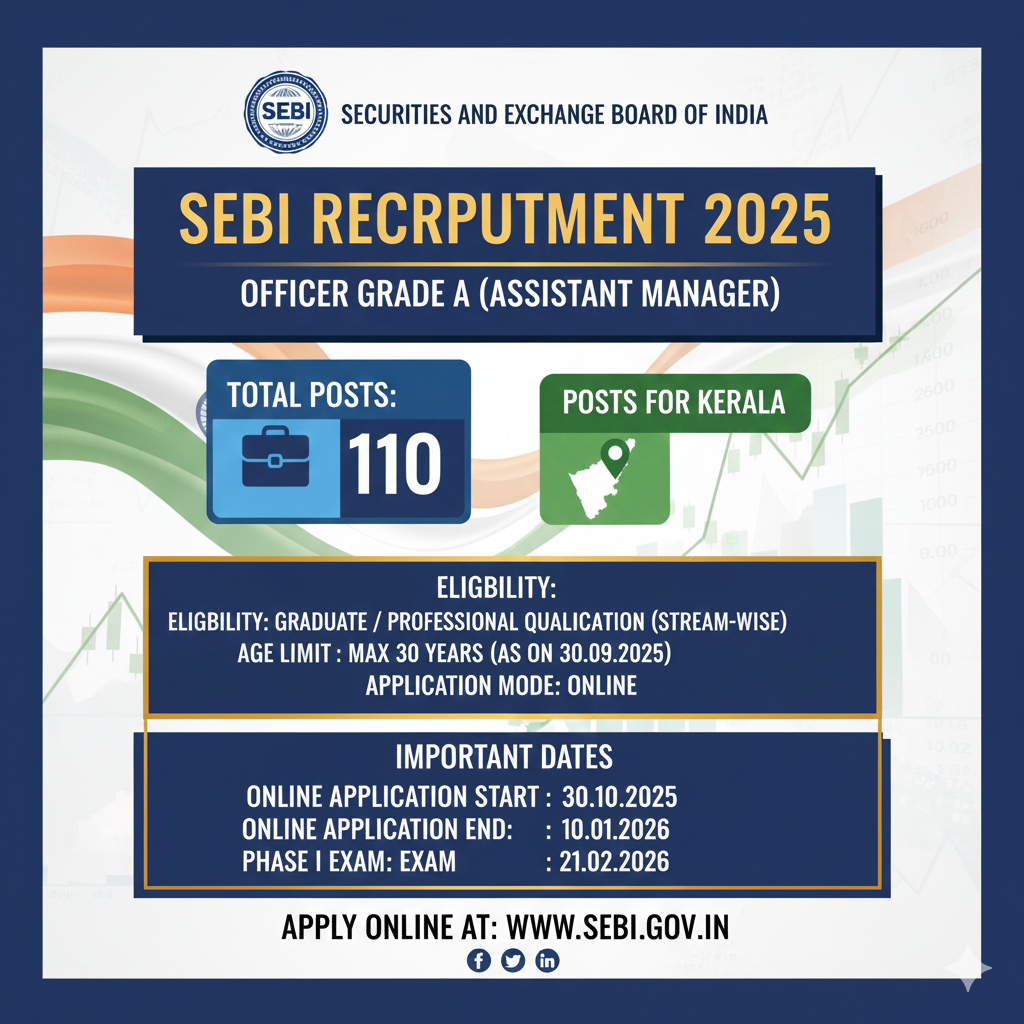
The recruitment is typically conducted for multiple specialized streams, as SEBI is a complex regulatory body. While your image mentioned a total of 110 posts, the vacancies are distributed across the following streams:
| Stream | Focus Area | General Eligibility Summary |
| General | Policy, Regulation, Market Supervision | Master's Degree in any discipline OR Bachelor's in Law/Engineering OR Professional Qualifications (CA/CS/CFA/CMA). |
| Legal | Legal and Regulatory Enforcement | Bachelor's Degree in Law (LLB). |
| Information Technology (IT) | Technology, Cyber Security, Data Analytics | Bachelor's Degree in Engineering (any stream) OR Master's in Computer Science/IT/Applications. |
| Research | Economic Analysis, Market Research | Master's Degree in Economics/Statistics/Finance/Business Administration (Finance). |
| Official Language | Compliance with Official Language Policy | Master's Degree in Hindi/Hindi Translation with English as a subject at the Bachelor's level. |
| Engineering (Electrical/Civil) | Maintenance of premises and infrastructure | Bachelor's Degree in the respective Engineering discipline. |
2. Core Eligibility Criteria
The minimum requirements that all candidates must fulfill, irrespective of their stream, are:
A. Age Limit (as on 30.09.2025)
Maximum Age: The candidate's age must not exceed 30 years as of September 30, 2025.
(This means a candidate must have been born on or after October 01, 1995.)
Age Relaxation: Standard relaxations are applicable for reserved categories (SC/ST: 5 years, OBC (NCL): 3 years, PwBD: 10-15 years) as per Government of India rules.
B. Educational Qualification
The qualifications are stream-specific (see the table above), but the minimum is a Graduate degree or a professional qualification.
Note for Final Year Students: Candidates in the final year/semester of their qualifying degree are often allowed to apply, but they must possess the final mark sheet/certificate proving their eligibility before the interview stage.
3. Selection Process (3 Phases)
The selection for the SEBI Grade A post is a rigorous, three-stage process:
| Phase | Type of Exam | Purpose | Weightage in Final Score |
| Phase I | Online Screening Exam (Objective) | Qualifying only. Marks do not count in the final merit list. | 0% |
| Phase II | Online Exam (Objective + Descriptive) | Crucial for shortlisting and final merit list. Includes stream-specific papers and English Descriptive. | $\approx 85\%$ |
| Phase III | Interview | Assesses personality, domain knowledge, and communication skills. | $\approx 15\%$ |
Phase I (Screening)
Paper 1 (Common for All): MCQs on General Awareness, English Language, Quantitative Aptitude, and Reasoning.
Paper 2 (Stream Specific): MCQs covering subjects relevant to the stream (e.g., General Stream covers Commerce, Accountancy, Finance, etc.).
Phase II (Main Exam)
Paper 1 (Common for All): English (Descriptive Test) to evaluate drafting skills, expression, and comprehension.
Paper 2 (Stream Specific): Objective type questions on specialized subjects related to the chosen stream.
4. Salary and Job Profile
Pay Scale & Salary: SEBI offers one of the best salaries in the regulatory sector. The approximate Gross Monthly Salary for a Grade A Officer is around ₹1,84,000 (without SEBI accommodation) at the Head Office. The pay scale is long and provides excellent growth over the years.
Job Role: An Officer Grade A (Assistant Manager) is an Executive Cadre position. The role involves regulating the Indian securities market, ensuring investor protection, and promoting market development. Duties can include policy formulation, inspection of intermediaries, investigation, and enforcement actions across various departments.
5. Application Details Summary
Application Period: October 30, 2025 to November 28, 2025.
Mode: Only Online application is accepted through the official SEBI website.
Projected Exam Dates: Phase I is tentatively scheduled for January 10, 2026, and Phase II for February 21, 2026.
📚 Phase I Syllabus (Screening)
Phase I is a qualifying round (marks are not counted in the final merit). It consists of two objective-type papers:
Paper 1: General (Common for All Streams)
(Maximum Marks: 100 | Duration: 60 minutes | Qualifying Cut-off: 30%)
This paper tests general aptitude and awareness:
General Awareness (GA): Emphasis on questions related to the Financial Sector, including SEBI regulations, RBI updates, economic news, government schemes, and current affairs of national and international importance.
English Language: Grammar, Vocabulary, Reading Comprehension, Cloze Test, Para Jumbles, and Error Spotting.
Quantitative Aptitude (Quant): Simplification/Approximation, Data Interpretation (DI), Number Series, Ratio & Proportion, Time & Work, Speed, Distance & Time, and basic Arithmetic topics.
Test of Reasoning (Reasoning): Puzzles, Seating Arrangement, Syllogism, Coding-Decoding, Inequalities, and Input-Output.
Paper 2: General Stream (Stream-Specific)
(Maximum Marks: 100 | Duration: 40 minutes | Sectional Cut-off: 40%)
This paper consists of Multiple Choice Questions (MCQs) covering the following six core subjects:
Commerce & Accountancy: Accounting Standards (Depreciation, Inventories, Revenue Recognition, Fixed Assets), Financial Analysis (Cash Flow/Fund Flow Statement, Ratio Analysis).
Management: Principles of Management (Planning, Organizing, Staffing, Directing, Controlling), Leadership Styles & Theories, Human Resource Development (HRD), Motivation, and Communication.
Finance: Financial System (Role and Functions of Regulatory bodies like RBI, SEBI), Financial Markets (Primary, Secondary, Forex, Money, Bond, Equity), Derivatives (Forwards, Futures, Swaps), and recent financial sector developments.
Costing: Overview of Cost and Management Accounting, Methods of Costing (Unit, Job, Batch, Process, Service Sector), Cost Control & Analysis (Standard Costing, Marginal Costing, Budgeting).
Companies Act, 2013: Specific chapters focusing on the Accounts of Company (Chapter IX) and Remuneration of Managerial Personnel (Chapter XIII), along with basic definitions and concepts.
Economics: Macroeconomic Theories (Classical vs. Keynesian, IS-LM Model), National Income (Concepts and Measurement), Inflation and Business Cycles, External Sector (Balance of Payments, Foreign Exchange Markets).
✍️ Phase II Syllabus (Main Examination)
Phase II marks are counted towards the final merit list and consists of two papers.
Paper 1: English (Descriptive Test)
(Maximum Marks: 100 | Duration: 60 minutes | Sectional Cut-off: 30% | Weightage: $1/3^{\text{rd}}$)
This paper is a descriptive test common to all streams, testing the candidate's drafting and communication skills. It typically includes:
Essay Writing
Precis Writing
Reading Comprehension
Paper 2: General Stream (Objective)
(Maximum Marks: 100 | Duration: 90 minutes | Sectional Cut-off: 40% | Weightage: $2/3^{\text{rd}}$)
This paper is also based on the same six subjects as Phase I Paper 2, but the questions are generally of a higher difficulty level and may be more application-based.
Subjects: Commerce & Accountancy, Management, Finance, Costing, Companies Act, and Economics.
IMPORTANT LINK
| OFFICIAL NOTIFICATION | CLICK HERE |
| APPLY ONLINE | CLICK HERE |
| OFFICIAL WEBSITE | CLICK HERE |
Comments (0)
Categories
Recent posts

⚕️ CCRH Recruitment 2025
6 Nov 2025
BEL Probationary Engineer Recruitment ...
25 Oct 2025.png)
IWAI Recruitment 2025
9 Oct 2025