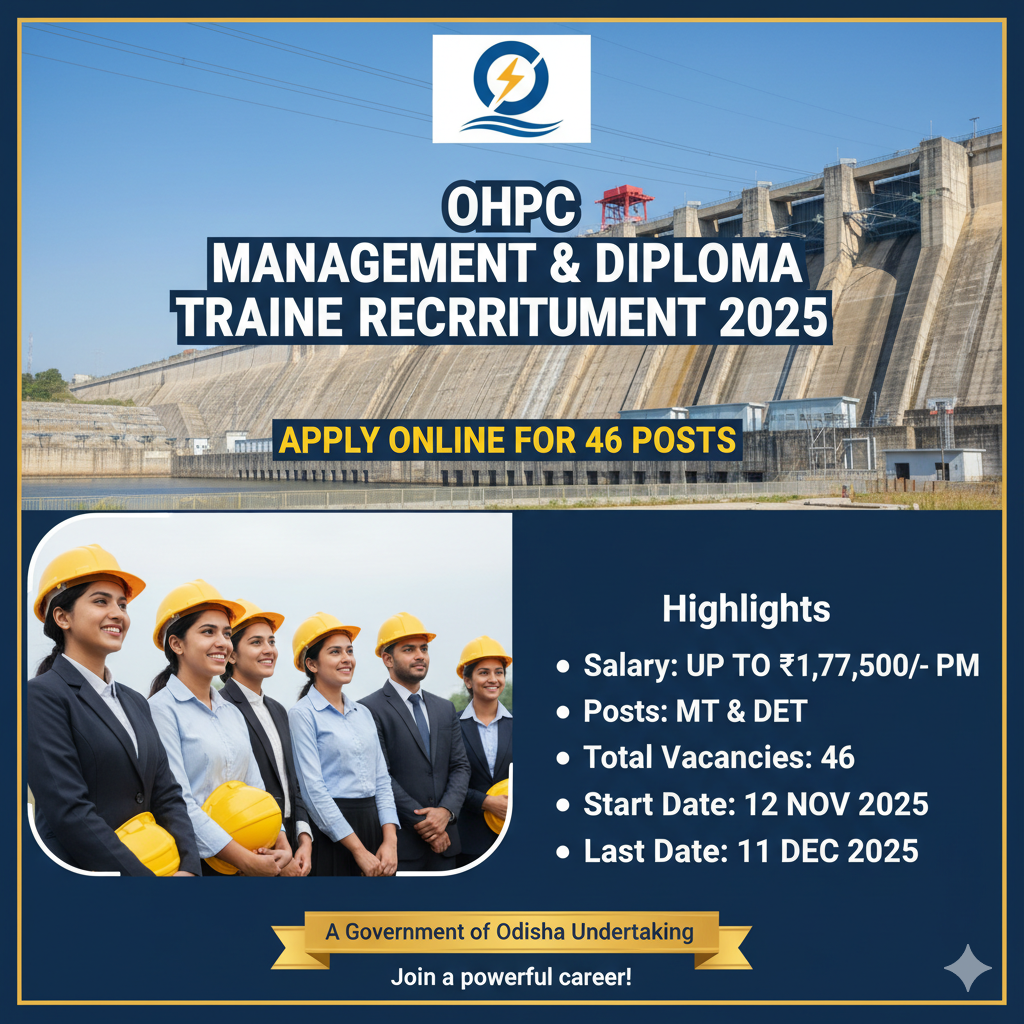
The OHPC Management & Diploma Trainee Recruitment 2025 is a major hiring drive by the Odisha Hydro Power Corporation Ltd. (OHPC) for a total of 46 vacancies across Management Trainee (MT) and Diploma Engineer Trainee (DET) posts.
📅 Important Dates
| Activity | Date |
| Online Application Start Date | 12th November 2025 |
| Last Date for Online Application | 11th December 2025 |
| Last Date for Fee Payment (Online) | 11th December 2025 |
| Tentative Date of Computer Based Test (CBT) | January / February 2026 |
💼 Vacancy Breakdown (46 Posts)
The recruitment targets both degree-level (MT) and diploma-level (DET) professionals. The largest number of vacancies is for the Electrical discipline.
| Post Name | Discipline | Total Vacancies |
| Management Trainee (MT) | HR | 04 |
| Management Trainee (MT) | Finance | 05 |
| Management Trainee (MT) | Legal | 01 |
| Management Trainee (MT) | Secretarial | 01 |
| Management Trainee (MT) | PR | 01 |
| Diploma Engineer Trainee (DET) | Electrical | 33 |
| Diploma Engineer Trainee (DET) | Civil | 01 |
| Total | 46 |
🎓 Eligibility Criteria
1. Educational Qualification (Minimum 60% marks in qualifying degree/diploma, 50% for SC/ST/PWD)
| Post Name | Required Educational Qualification |
| MT (HR) | Full-time 2-year PG Degree/Diploma or MBA with specialization in HR/PM/IR/HRD. |
| MT (Finance) | Degree in any discipline with CA/CMA. |
| MT (Legal) | Full-time LLB degree. |
| MT (Secretarial) | Graduate with ACS/FCS (Associate/Fellow Member of ICSI). |
| MT (PR) | Full-time Degree with a 2-year PG Diploma in Journalism & Mass Communication. |
| DET (Electrical) | Full-time Diploma in Electrical Engineering or Electrical & Electronics Engineering. |
| DET (Civil) | Full-time Diploma in Civil Engineering. |
2. Age Limit (as of 01.08.2025)
MTs: 21 years to 32 years.
DETs: 18 years to 32 years.
Age Relaxation: 5 years for SC/ST/SEBC/Women/Ex-Serviceman; 10 years for PWD candidates.
3. Odia Language Requirement
Candidates must be able to read, write, and speak Odia fluently and satisfy one of the specified criteria (e.g., passed Odia as a language subject in Middle School or HSC/10th).
💰 Salary and Benefits
This recruitment offers a highly competitive package, including a substantial stipend during training and a high pay scale upon regularization.
| Stage | Post Name | Stipend/Grade/Pay Scale | Initial Basic Pay |
| Training (1 Year) | MT | Consolidated Stipend of ₹50,000/- per month | - |
| Training (1 Year) | DET | Consolidated Stipend of ₹40,000/- per month | - |
| After Training | MT (Asst. Manager, E-3 Grade) | Pay Scale: ₹56,100/- to ₹1,77,500/- | ₹56,100/- |
| After Training | DET (Junior Manager, E-2 Grade) | Pay Scale: ₹44,900/- to ₹1,42,400/- | ₹44,900/- |
Additional Benefits: Trainees receive a medical allowance of ₹200/- per month, and a remote area allowance of ₹1,000/- per month if posted at specific sites.
Post-Regularization: In addition to basic pay, appointees receive Dearness Allowance (DA), House Rent Allowance (HRA), and other allowances as per OHPC rules.
Service Bond: Selected candidates are required to sign a 3-year service agreement bond.
✅ Selection Process
The selection is a two-stage process based entirely on the written test performance.
Tier 1: Computer Based Test (CBT)
Type: Multiple Choice Questions (MCQs).
Total Questions: 120.
Total Marks: 120 (1 mark per question).
Duration: 2 Hours (120 minutes).
Negative Marking: 0.25 marks deducted for every wrong answer.
Structure:
Part I: General Aptitude (Quantitative Aptitude, Reasoning, English, General Awareness) - 40 Questions.
Part II: Subject Knowledge (Respective Discipline) - 80 Questions.
Tier 2: Document Verification
Candidates will be shortlisted based on their merit in the CBT and called for a Document Verification round in Bhubaneswar to confirm their eligibility and credentials.
📝 Application Fee
The fee is non-refundable and must be paid online.
| Category | Application Fee |
| UR (Unreserved) | ₹750/- |
| SEBC | ₹750/- |
| SC/ST (of Odisha only) | Nil |
| PWD Candidates | Nil |
The selection process for the OHPC Management Trainee (MT) and Diploma Engineer Trainee (DET) posts is based entirely on a Computer Based Test (CBT), which is divided into two main parts.
The syllabus is consistent with previous OHPC recruitment drives for similar positions and is broadly divided into a common General Aptitude section and a discipline-specific Subject Knowledge section.
📚 OHPC Trainee CBT Syllabus
The CBT consists of 120 Multiple Choice Questions (MCQs) to be completed in 2 hours.
Part I: General Aptitude (40 Questions)
This section is common for all MT and DET posts and covers general mental ability and awareness.
| Subject | Key Topics |
| Quantitative Aptitude | Number System, Simplification, Ratio and Proportion, Percentage, Partnership, Profit and Loss, Time and Work, Time, Speed and Distance, Simple and Compound Interest, Mensuration, Data Interpretation. |
| Reasoning | Alphabetical Series, Coding-Decoding, Directions and Distance, Blood Relations, Syllogism, Seating Arrangements, Puzzles, Analogy, Classification, Non-Verbal Reasoning (Cubes, Dice, Water/Mirror Images, etc.). |
| General English | Reading Comprehension, Cloze Test, Error Correction, Sentence Improvement/Rearrangement, Synonyms and Antonyms, Idioms and Phrases, One-word Substitution. |
| General Awareness | Current Affairs (National & International), History (Indian), Polity, Indian Economy, Geography (India), Scientific & Technological Developments, Books and Authors, Sports. |
Part II: Subject Knowledge (80 Questions)
This section is discipline-specific. The core subjects are derived from the curriculum of the respective qualifying degree/diploma (Diploma for DET, PG/CA/CMA/LLB for MT).
1. Diploma Engineer Trainee (DET) Electrical Syllabus
| Core Subject Areas | Detailed Topics (Expected) |
| Electrical Basics & Materials | Electrical Engineering Materials, Fundamentals of Electricity, Magnetism and Electromagnetism. |
| Circuit & Network Theory | DC/AC Circuits, Network Graphs and Matrices, Transient and Steady-State Analysis, Two-Port Network Parameters. |
| DC/AC Machines & Transformers | Construction, Working Principle, Characteristics, Testing, and applications of DC Motors & Generators, Single-Phase & Three-Phase Transformers, Induction Motors, and Synchronous Machines. |
| Electrical Measurements | Measuring Instruments (PMMC, MI, Electrodynamometer), Measurement of Power, Energy, Resistance, Bridges. |
| Power System | Generation, Transmission and Distribution of Electrical Power, Switchgear and Protection (Fuses, Circuit Breakers, Relays). |
| Analog & Digital Electronics | Diodes, BJTs, FETs, Amplifier Circuits, Operational Amplifiers, Boolean Algebra, Logic Gates, Combinational & Sequential Circuits. |
| Control Systems | Block Diagram, Transfer Function, Time Response, Stability Analysis. |
| Power Electronics & Drives | Thyristors, Inverters, Choppers, Cycloconverters, and their applications in electrical drives. |
2. Management Trainee (MT) Finance Syllabus (Degree with CA/CMA)
| Core Subject Areas | Detailed Topics (Expected) |
| Financial Accounting | Accounting Standards (AS), Partnership Accounts, Accounts from Incomplete Records, Amalgamation, Liquidation of Companies, Joint Ventures, Accounts of Non-Trading Concerns. |
| Cost & Management Accounting | Costing Methods (Job, Batch, Process), Standard Costing, Marginal Costing, Budgetary Control, Enterprise Performance Management (EPM). |
| Taxation | Indirect & Direct Tax Management (Basics of Income Tax and GST). |
| Financial Management | Capital Budgeting, Working Capital Management, Cost of Capital, Capital Structure Theories, Valuation. |
| Auditing & Law | The Companies Act, 2013 (Provisions relating to Audit, Cost Audit), Industrial and other relevant Laws. |
3. Management Trainee (MT) HR Syllabus
| Core Subject Areas | Detailed Topics (Expected) |
| Human Resource Management (HRM) | HR Planning, Recruitment & Selection, Placement & Induction, Compensation Management, HR Audits, Performance Management & Appraisal. |
| Organizational Behaviour (OB) | Theories of Motivation, Leadership Theories, Communication, Conflict Management, Individual & Group Behaviour. |
| Industrial Relations (IR) | Trade Unionism, Collective Bargaining, Workers' Participation in Management, Grievance and Discipline. |
| Labour Legislation | Detailed knowledge of major Labour Laws (e.g., Industrial Disputes Act, Trade Unions Act, ESI Act, EPF Act, Payment of Gratuity Act, Factories Act, Code on Wages 2019, POSH Act). |
Note: The official notification PDF is the most definitive source for the exact syllabus. The topics listed above are based on detailed syllabus breakdowns from previous OHPC MT/DET recruitments and cover the highly likely content for your preparation.
Essential Links
Here are all the important links you’ll need for this recruitment process.
YouTube Instagram WhatsApp Telegram
Comments (0)
Categories
Recent posts

⚕️ CCRH Recruitment 2025
6 Nov 2025
BEL Probationary Engineer Recruitment ...
25 Oct 2025.png)
IWAI Recruitment 2025
9 Oct 2025