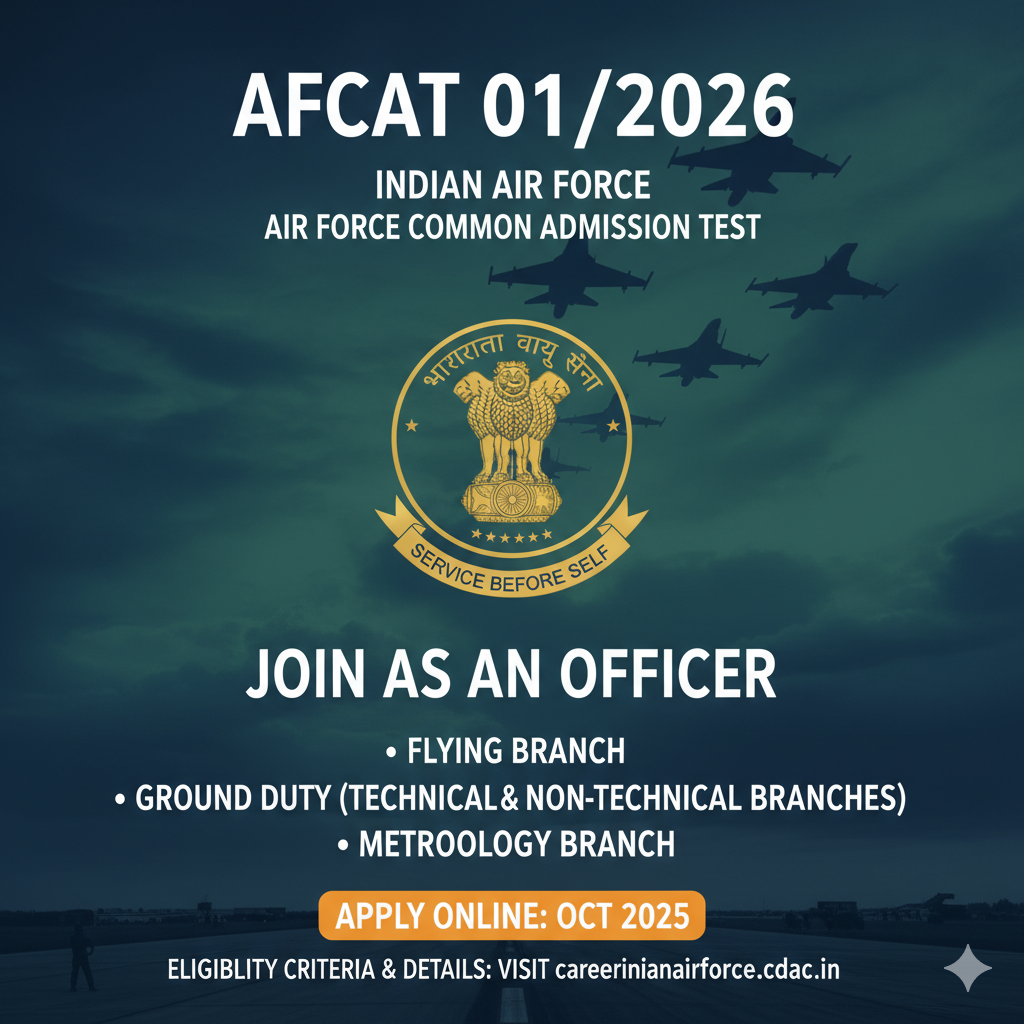
AFCAT 01/2026 recruitment
🎯 AFCAT 01/2026: Key Opportunity and Dates
This recruitment notification, AFCAT 01/2026, presents a significant opportunity for aspirants to join the Indian Air Force (IAF) as Commissioned Officers in the Flying and Ground Duty (Technical/Non-Technical) branches. These are Group 'A' Gazetted Officer positions.
Course Commencing: January 2027
Application Window: 17 November 2025 to 14 December 2025
AFCAT Exam Date: 31 January 2026
Post Names: Commissioned Officers (Flying, Ground Duty Technical, Ground Duty Non-Technical)
Salary (Flying Officer): Level 10 (₹56,100 – ₹1,77,500) + MSP ₹15,500
📊 Branch-wise Vacancy Details
The recruitment covers both Permanent Commission (PC) and Short Service Commission (SSC). SSC is open to both men and women across branches, while PC is primarily for men (with some PC posts for women in the Technical branch).
| Entry | Branch | Commission | Men | Women |
| AFCAT | Flying | SSC | 34 | 04 |
| AFCAT | Ground Duty (Technical) | PC / SSC | 150 (Total) | 38 (Total) |
| AFCAT | Ground Duty (Non-Technical) | SSC | 90 (Total) | 25 (Total) |
| NCC Special Entry | Flying | PC / SSC | 10% of CDSE/AFCAT Vacancies | 10% of AFCAT Vacancies |
Disclaimer: The vacancies are tentative and subject to change based on service requirements.
🎓 Eligibility Criteria
1. Age Limit (Calculated as on 01 January 2027)
| Branch | Age Limit | Date of Birth Range | Relaxation |
| Flying Branch | 20 to 24 years | 02 January 2003 to 01 January 2007 | Upper age limit is relaxed up to 26 years for valid CPL Holders (Born: 02 Jan 2001 to 01 Jan 2007) |
| Ground Duty (Technical/Non-Technical) | 20 to 26 years | 02 January 2001 to 01 January 2007 | No additional age relaxation |
2. Educational Qualification
| Branch | Mandatory 10+2 Qualification | Graduation/Other Required Qualification |
| Flying Branch | Mandatory 50% marks each in Mathematics and Physics at 10+2 level. | Minimum 3-year graduation degree in any discipline with 60% marks OR B.E./B.Tech (4-year course) with 60% marks. |
| Ground Duty (Technical) AE(L) / AE(M) | Mandatory 50% marks each in Mathematics and Physics at 10+2 level. | Minimum 4-year degree or integrated Post-Graduation in relevant Engineering/Technology disciplines with 60% marks. |
| Ground Duty (Non-Technical) (Weapon Systems) | Mandatory 50% marks each in Mathematics and Physics at 10+2 level. | Minimum 3-year graduation degree in any discipline with 60% marks OR B.E./B.Tech (4-year course) with 60% marks. |
| Ground Duty (Non-Technical) (Admin & Logistics) | Passed 10+2 | Minimum 3-year graduate degree in any discipline with 60% marks. |
| Ground Duty (Non-Technical) (Accounts) | Passed 10+2 | B.Com Degree (min 3 years) with 60% marks OR BBA/BMS/BBS (with finance specialization) with 60% marks OR Qualified CA/CMA/CS/CFA. |
| Ground Duty (Non-Technical) (Education) | Passed 10+2 | Post-Graduation with 50% marks and Graduation with 60% marks. |
| Ground Duty (Non-Technical) (Meteorology) | Passed 10+2 | B.Sc. (with Physics and Mathematics) with 60% marks OR 4-year B.E./B.Tech in specified streams with 60% marks. |
Final Year Students: Candidates in the final year of their degree can apply, provided they have no present backlog and maintain a minimum of 60% marks till the last semester/year. They must produce the passing certificate by 30 November 2026.
💰 Salary and Benefits
A Flying Officer is compensated as per the 7th Central Pay Commission (CPC) at Pay Level 10.
Basic Pay: ₹56,100/- per month
Military Service Pay (MSP): ₹15,500/- per month
Total Starting Pay (Basic + MSP): ₹71,600/- per month (excluding allowances)
Allowances: Flying Allowance (for Flying Branch), Transport Allowance, Technical Allowance, Dearness Allowance (DA), Risk and Hardship Allowance, etc.
Other Perks: Medical cover, Canteen (CSD) facilities, furnished accommodation, and a substantial insurance cover of ₹1.25 crore.
Stipend during Training: A fixed stipend of ₹56,100 per month.
📝 Selection Process - Three Stages
Stage 1: AFCAT Written Examination (Online CBT)
Subjects: General Awareness, Verbal Ability in English, Numerical Ability, and Reasoning & Military Aptitude.
Marking Scheme: 3 marks for every correct answer, 1 mark deducted for every incorrect answer (negative marking).
Candidates for Ground Duty (Technical) must also appear for the Engineering Knowledge Test (EKT) along with AFCAT.
Stage 2: Air Force Selection Board (AFSB) Interview
Candidates who clear the AFCAT cut-off are called for a multi-day AFSB interview process designed to assess their personality, psychology, and leadership potential.
Testing includes a Screening Test (OIR and PP&DT), Psychological Tests, Group Tests, and a Personal Interview.
Stage 3: Medical Examination
Candidates recommended by the AFSB proceed to a thorough medical and physical examination. Final selection is subject to meeting the prescribed medical standards of the IAF.
💻 How to Apply Online
The application process is exclusively online, starting on 17 November 2025.
Registration: Visit the official AFCAT portal and click on "New Candidate Registration." Register by providing basic details, including your Aadhaar Card Number, name, email ID, and mobile number.
Form Filling: Log in using the generated credentials and fill in your personal, educational, and communication details carefully.
Document Upload: Upload scanned copies of your recent passport-size colour photograph, signature, and thumb impression (Left for men, Right for women) in the prescribed format. A "Live Image Capture" via your device's camera will also be required.
Fee Payment: Pay the application fee of ₹550/- + 18% GST online using a debit card, credit card, or net banking. (NCC Special Entry is exempt from the fee).
Final Submission: Review the form and submit. Take a printout of the final application for future reference.
📅 Important Dates
| Event | Date |
| Online Application Starts | 17 November 2025 |
| Online Application Closes | 14 December 2025 |
| AFCAT Online Exam Date | 31 January 2026 |
| Course Commencing Date | January 2027 |
Advice: It is highly recommended that candidates complete the application process well before the closing date to avoid any last-minute technical difficulties.
The AFCAT 01/2026 examination consists of the Air Force Common Admission Test (AFCAT) for all candidates and the Engineering Knowledge Test (EKT) exclusively for Ground Duty (Technical) branch applicants.
The AFCAT syllabus is divided into four main sections, with the overall standard of questions being of the graduation level (except Numerical Ability, which is of the matriculation level).
📝 AFCAT Written Exam Syllabus (For All Branches)
The AFCAT paper has 100 questions for a total of 300 marks and a duration of 2 hours. There is a negative marking of -1 mark for every incorrect answer.
| Section | No. of Questions (Approx.) | Maximum Marks | Key Topics Covered (Indicative) |
| Verbal Ability in English | 30 | 90 | Comprehension, Error Detection, Sentence Completion, Synonyms/Antonyms, Cloze Test, Idioms & Phrases, Analogy, One Word Substitution. |
| General Awareness | 25 | 75 | History, Geography, Indian Polity, Economy, Environment, Basic Science, Defence, Current Affairs (National & International), Sports, Art & Culture, Personalities. |
| Numerical Ability | 20 | 60 | Decimal Fractions, Ratio & Proportion, Percentage, Profit & Loss, Simple & Compound Interest, Time & Work, Time & Distance (Trains/Boats & Streams), Area and Perimeter, Probability, Number System. |
| Reasoning & Military Aptitude Test | 25 | 75 | Verbal & Non-Verbal Reasoning, Spatial Ability (figure classification, hidden figures, rotated figures), Logical Reasoning, Venn Diagrams, Data Interpretation. |
⚙️ Engineering Knowledge Test (EKT) Syllabus
The EKT is compulsory only for candidates applying for the Ground Duty (Technical) branch and is conducted immediately after the AFCAT written test.
Exam Pattern: 50 questions, 150 marks, 45 minutes duration, with -1 mark negative marking.
The syllabus focuses on the core and allied subjects of your engineering discipline. Candidates only attempt the EKT paper corresponding to their engineering stream.
1. Mechanical Engineering
Core: Engineering Mechanics, Fluid Mechanics/Hydraulic Machines, Thermodynamics, Theory of Machines, Machine Design, Materials Science, Manufacturing Science.
Allied: Aerodynamics, Aircraft Structures, Power Plant Engineering, Industrial Engineering, Automotive Engineering.
2. Computer Science Engineering
Core: Computer Networks, Data Structures, Operating Systems, Software Engineering, Database Management Systems (DBMS), Digital Electronics, Information Technology.
Allied: Switching Theory, Analog and Digital Electronics, Telecommunication Systems, Electrical Engineering, Control Engineering.
3. Electrical & Electronics Engineering
Core: Electrical Circuits, Analog & Digital Electronics, Electronic Devices, Control Systems, Communication Systems, Power Electronics, Electromagnetic Theory, Microprocessors.
Allied: Switching Theory, Information Technology, Computer Networks, Network Theory Design, Radar Theory, Instrumentation.
Essential Links
Stay connected with the official sources and get all the latest updates.
YouTube Instagram WhatsApp Telegram
Comments (0)
Categories
Recent posts

⚕️ CCRH Recruitment 2025
6 Nov 2025
BEL Probationary Engineer Recruitment ...
25 Oct 2025.png)
IWAI Recruitment 2025
9 Oct 2025